The roboflow.com/credits page mentions that 1 credit corresponds to 500 seconds of inference time. A more accurate formula is the following:
if x-remote-processing-time header is set:
   credits = (100ms + x-remote-processing-time) / 500,000ms
else:
   credits = max(x-processing-time, 100ms) / 500,000ms
Where x-processing-time and x-remote-processing-time are HTTP Response headers, in float format (seconds). See roboflow.com/pricing for credit pricing.
<sub>Model Inference</sub>
In the example below, we run inference on coco/39 model (RF-DETR Small, 560x560). In response headers we can find x-processing-time , which is 81ms. In this case, we'd have credits = max(81, 100) / 500,000 = 0.0002 credits , or 0.2 credits per 1000 images.
curl -X POST "https://serverless.roboflow.com/coco/39?api_key=$ROBOFLOW_API_KEY&image=https://media.roboflow.com/notebooks/examples/dog.jpeg" -I
HTTP/2 200
content-type: application/json
content-length: 995
x-model-cold-start: false
x-model-id: coco/39
x-processing-time: 0.08100700378417969
x-workspace-id: my-workspace-id
Cold start
If you run the same request a 10 minutes later, it could happen that the model has been unloaded and needs to be loaded to the GPU again - a cold start. Model loading can take up to a few seconds, and is highly correlated with the delay between inferences.
curl -X POST "https://serverless.roboflow.com/coco/39?api_key=$ROBOFLOW_API_KEY&image=https://media.roboflow.com/notebooks/examples/dog.jpeg" -I
HTTP/2 200
content-type: application/json
content-length: 995
x-model-cold-start: true
x-model-id: coco/39
x-model-load-details: [{"m": "coco/39", "t": 0.7791134570725262}]
x-model-load-time: 0.5791134570725262
x-processing-time: 1.1060344696044922
x-workspace-id: my-workspace-idFormula: credits = max(1106, 100)/500,000 = 0.0022 , or 2.2 credits per 1000 (cold start) images.
Workflow run
For Workflows, we split model inference from general Workflow processing. This means that Workflow itself will be executed on (cheaper) CPU-only machines, and only use GPU machines for model inference, resulting in a more cost-effective processing.
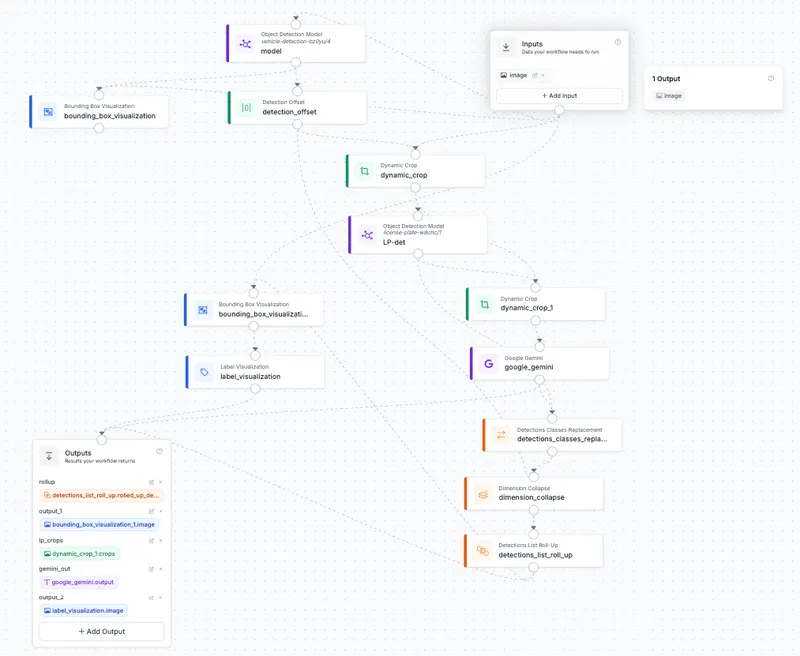
curl --location 'https://serverless.roboflow.com/my-workspace-id/workflows/lpr-workflow' -i \
--header 'Content-Type: application/json' \
--data '{
    "api_key": "API_KEY",
    "inputs": {
        "image": {"type": "url", "value": "https://media.roboflow.com/docs/cars-highway.png"}
    }
}'

HTTP/2 200
content-type: application/json
content-length: 2277416
x-model-cold-start: false
x-processing-time: 6.334797143936157
x-remote-processing-time: 1.0542614459991455
x-remote-processing-times: [{"m": "vehicle-detection-bz0yu/4", "t": 1.0091230869293213}, {"m": "license-plate-w8chc/1", "t": 0.017786026000976562}, {"m": "license-plate-w8chc/1", "t": 0.01506495475769043}, {"m": "license-plate-w8chc/1", "t": 0.012287378311157227}]
x-workspace-id: my-workspace-idFormula: credits = (100ms + 1054ms)/500,000 , so 0.0023 credits for processing, and some tiny amount for the Gemini API call (depending on token count, see roboflow.com/credits).
Failed requests
Requests that fail with status 402, 408, 409, 423, 429, or any 5xx code do not use credits. These cover server errors, timeouts, and rate limits.
Other failures, such as 401, 403, and 404, still use credits.